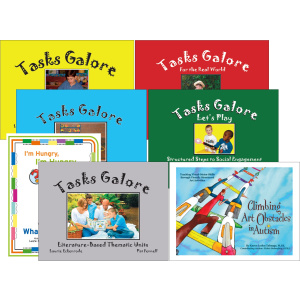
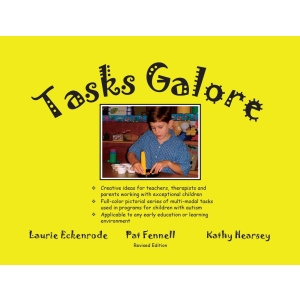
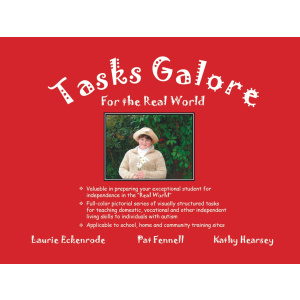
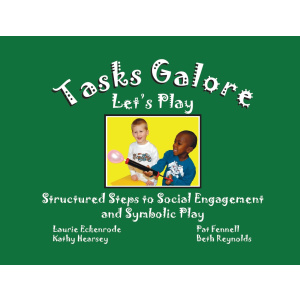
The Tasks Galore books were created to offer parents and professionals practical tools that help children and students in their care become more independent at school and in society. These tools highlight ‘Structured TEACCHing’ methods and promote collaboration between parents and professionals.

People working with students who cope with learning challenges such as autism, should keep in mind the features of structure that have proven useful in classrooms and programs for students of all ages. These features include the organization of physical space, scheduling, and teaching methods. The key to all of these features is individualization.

The mission of the Tasks Galore series is to help teachers, therapists, and parents design meaningful, individualized tasks with an emphasis on functional academics. All too often, children are left to attempt traditional pencil-and-paper tasks even when they are either incapable of doing the work or do not see the meaning of it. Teachers often are not quite sure how to present academic material in a hands-on approach. Many students with special needs learn best using a multi-modal approach to learning. They require movement or sensory input while processing and learning new information. The task ideas in Tasks Galore will help lay a foundation for that learning.

Is Structured Teaching Neuroaffirmative?

Yes, structured teaching, particularly the TEACCH approach, is widely considered neuroaffirmative because it is a strengths-based, student-centered method that creates predictable and comprehensible environments using visual supports and routines to promote independence and understanding for neurodivergent individuals, such as those with autism spectrum disorder (ASD). By accommodating neurodivergent needs rather than trying to change them, structured teaching aligns with neuroaffirmative principles.

How Structured Teaching is Neuroaffirmative:

  • Focus on the Individual: The TEACCH approach centers on understanding the individual's unique skills, needs, and interests, cultivating their strengths to support their overall development.
  • Creating Comprehensible Environments: Structured teaching organizes the physical environment, schedules, and tasks to be clear and predictable, which helps reduce anxiety and improve understanding for neurodivergent students who may struggle in unstructured settings.
  • Utilizing Visual Supports: The use of visual schedules, work systems, and defined work areas provides clear expectations and reduces barriers to learning, allowing students to navigate their environment and tasks independently.
  • Promoting Independence: A primary goal is to transfer the focus from teacher-led instruction to student-led learning, fostering independence and self-efficacy.
  • Building on Strengths: Instead of solely addressing challenges, structured teaching identifies and leverages an individual's unique talents and abilities as part of the teaching process.
  • Supporting Neurodiversity: By providing structure and predictability, the method accommodates neurodivergent learning styles and needs, rather than trying to impose a "typical" learning style, aligning with the core idea of neurodiversity affirmation.
0